Built withReact · TypeScript · SQLite · SSE
TROPY.
TROPY runs tournament nights with several disciplines, stations and devices. The system builds the brackets, coordinates the matches and tells players when, where and against whom they play. Organisers set the conditions, start the phases and step in when needed.
- Role
- Product concept, UX/UI system, AI-assisted prototyping
- Context
- Independent project · 2026
- Status
- Working prototype · first field test completed
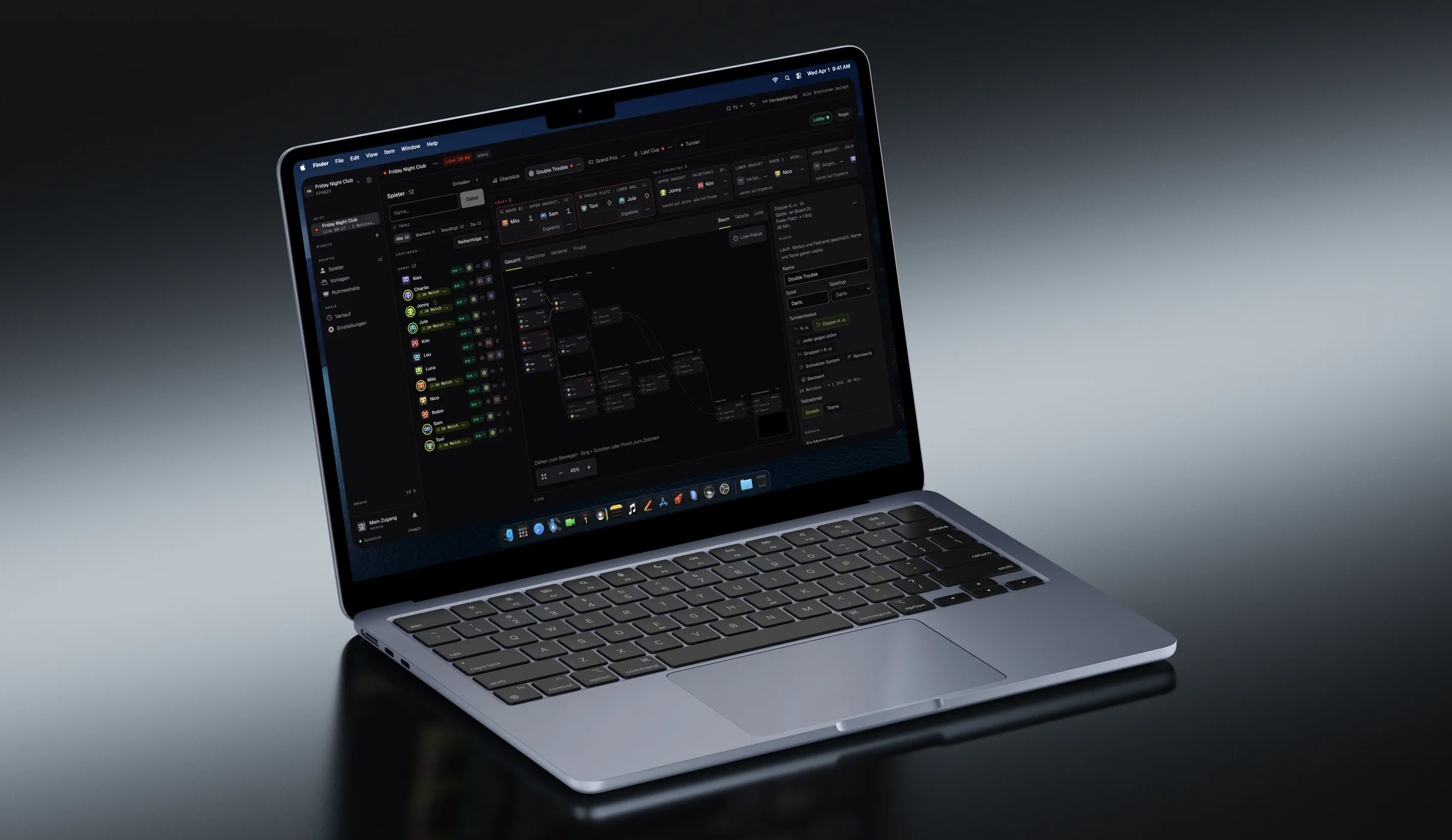
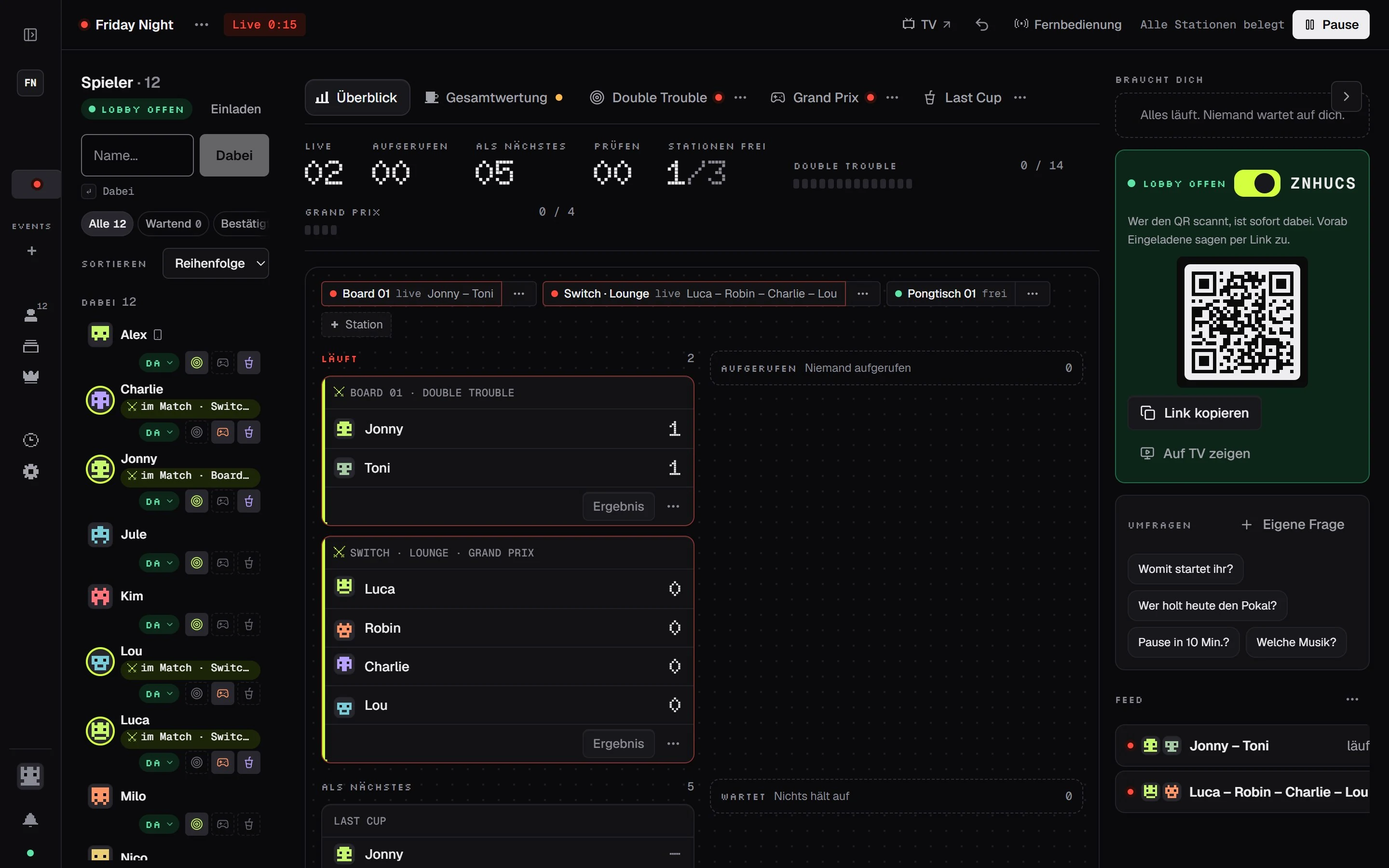
- Host consolecontrols the tournament.
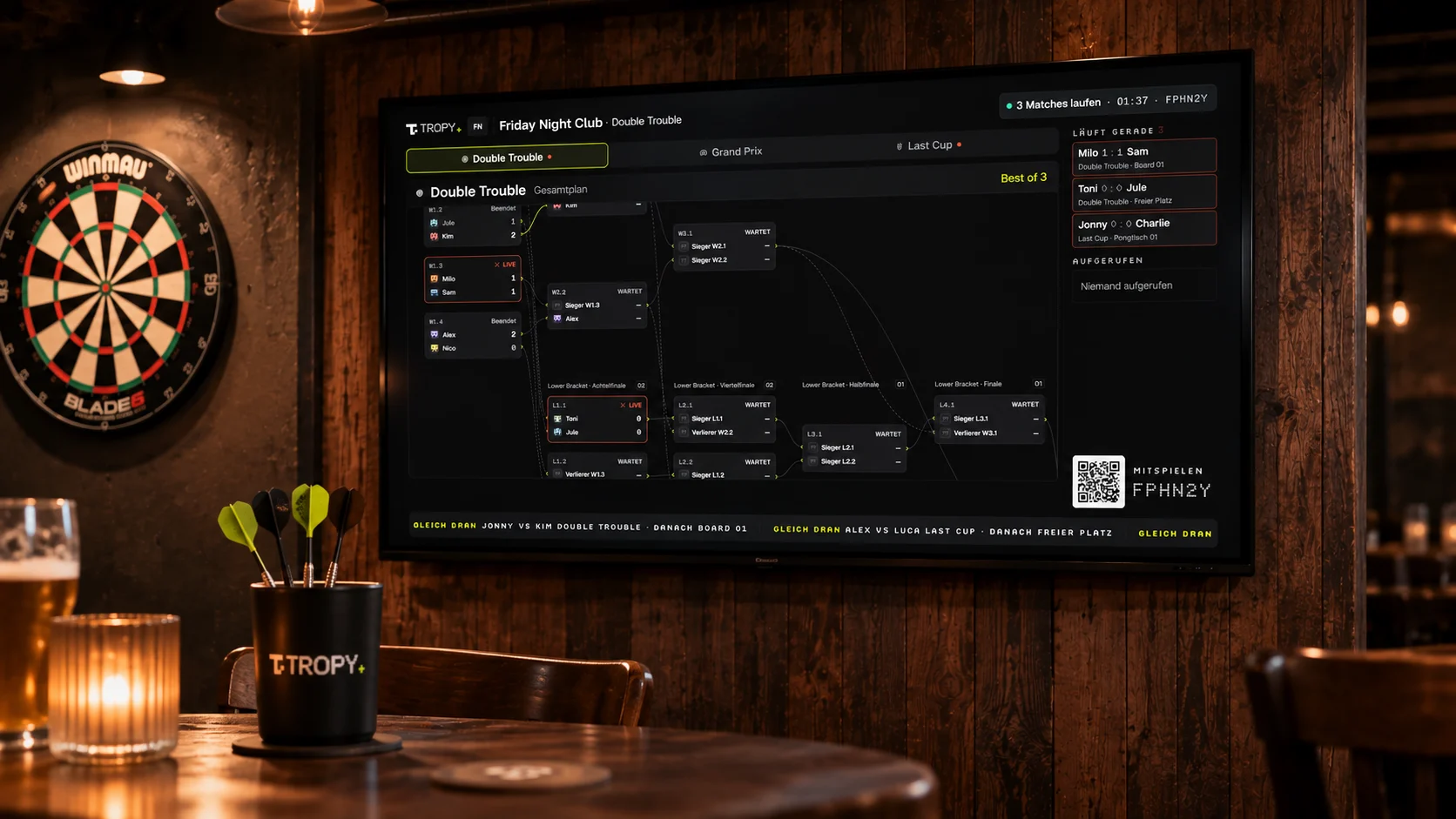
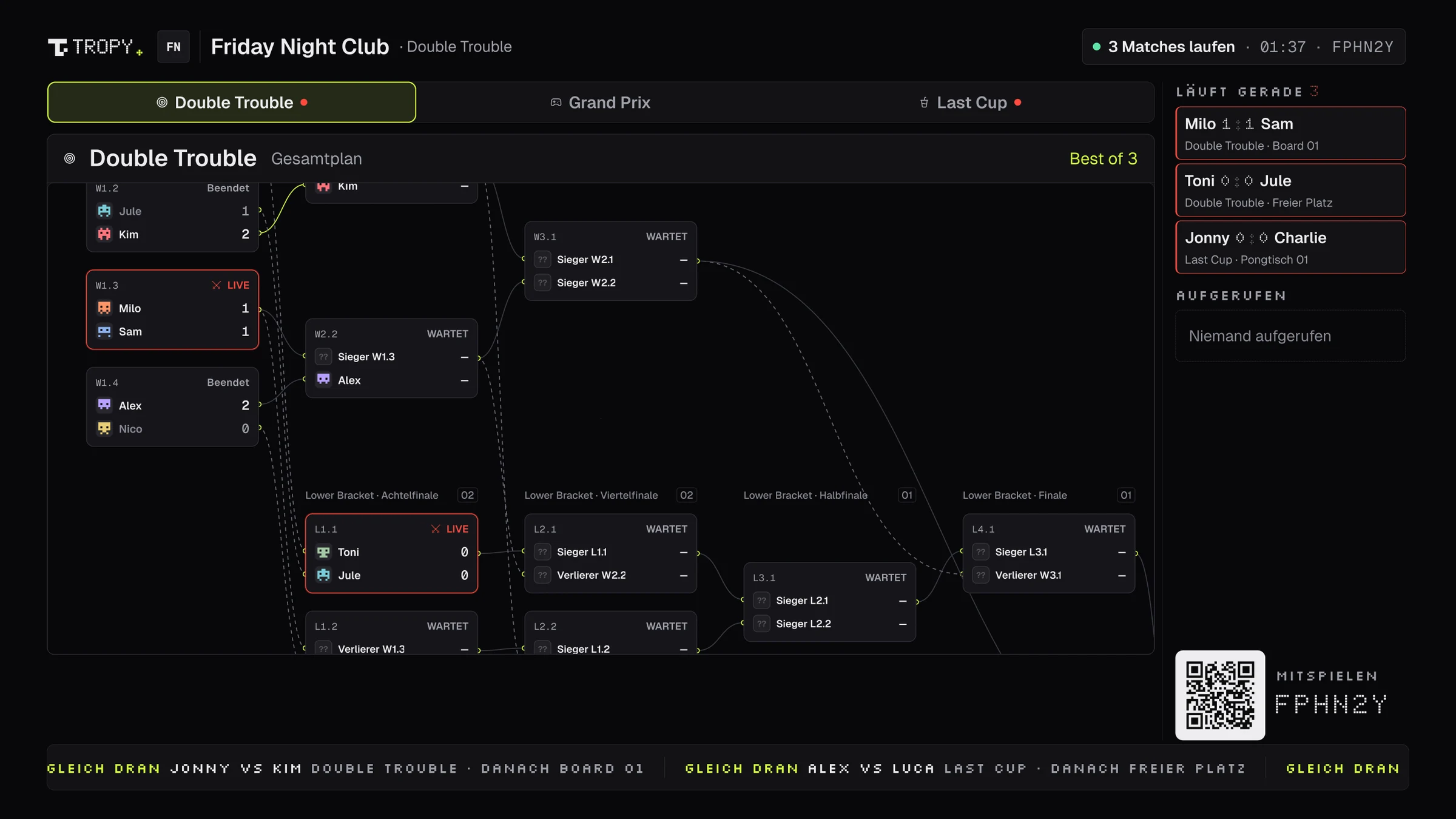
- TV stageshows the progress in the room.
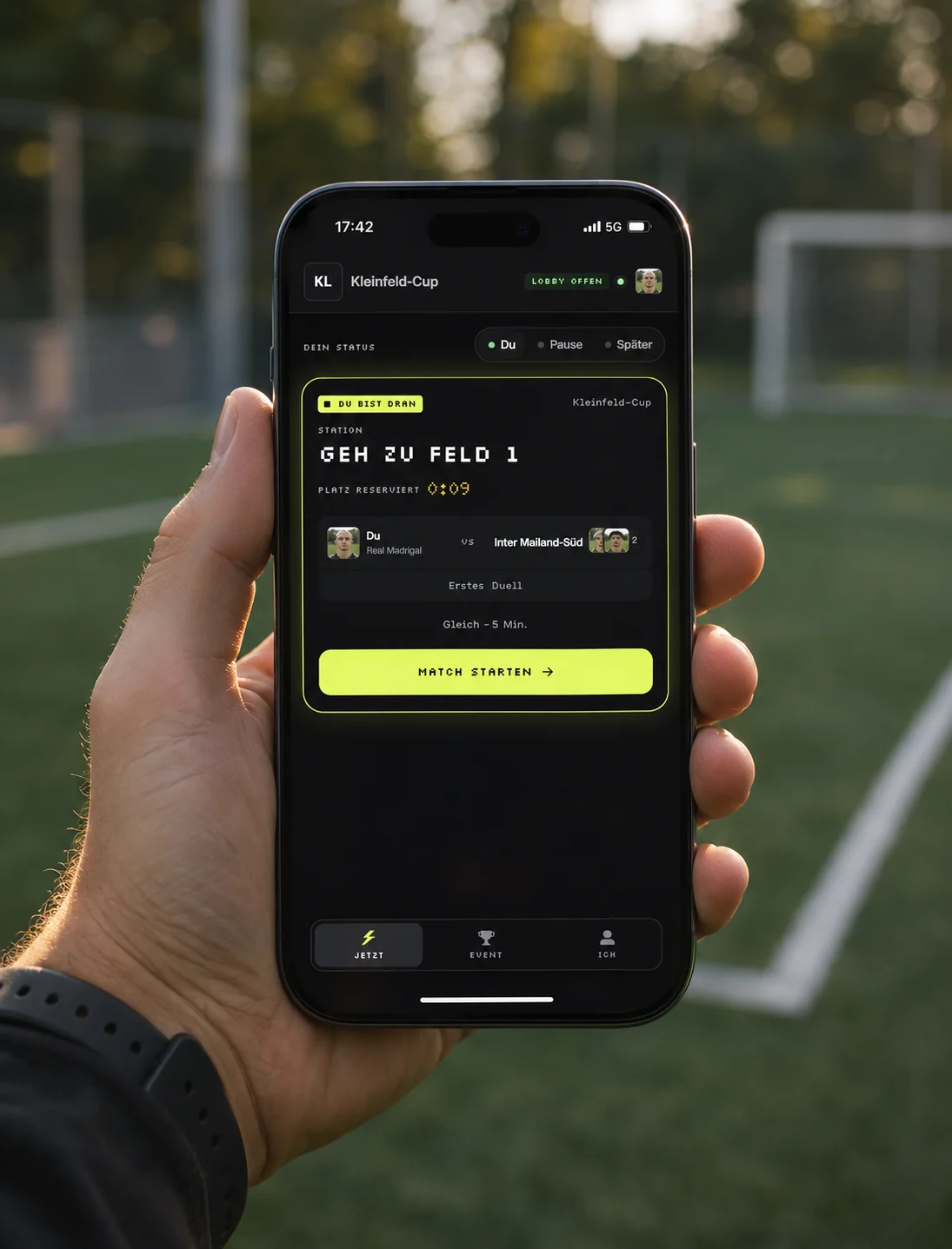
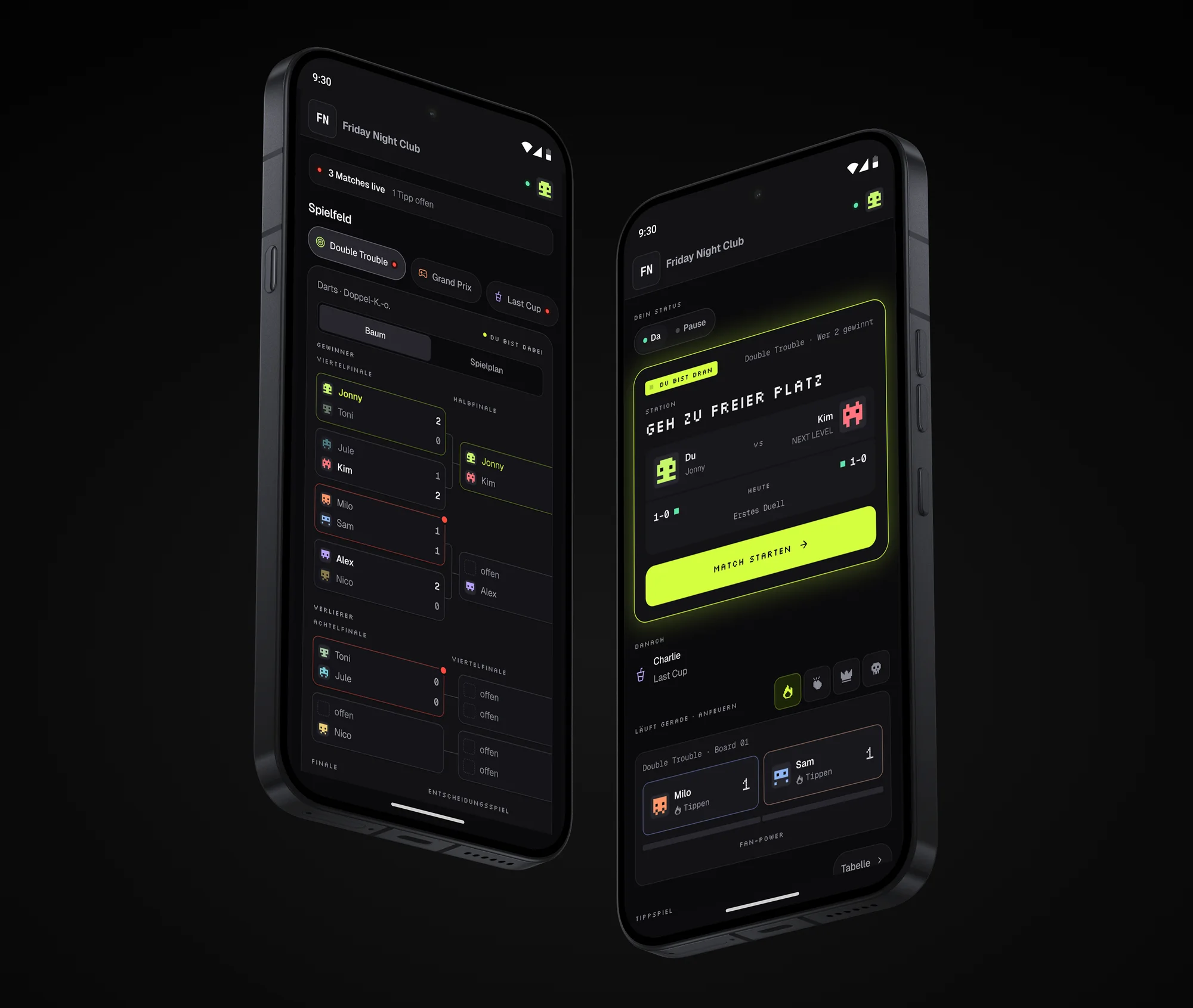
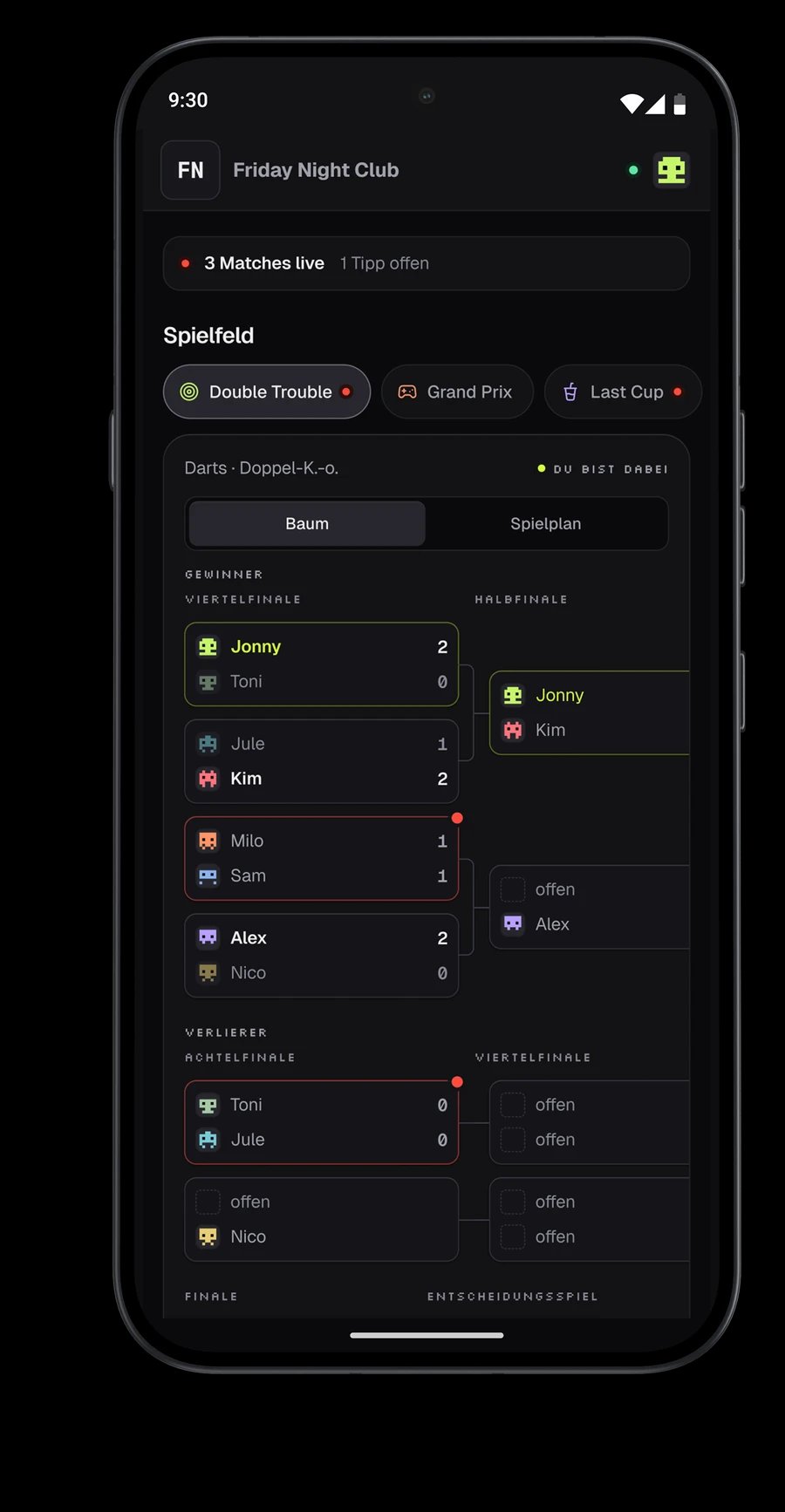
- Companionshows each player the information that matters to them.
Problem
My circle of friends regularly held tournaments in table tennis, darts or several disciplines. On nights with 3 disciplines, 3 schedules ran in parallel at 3 stations while the same participants moved between stations.
Drawing up the schedules by hand took time beforehand. During the tournaments, arrangements were mostly made verbally, so it often remained unclear which match came next at which station.
Questions, double bookings and waiting times drew out the evening. I built TROPY to create schedules automatically and coordinate matches while the night runs.
Analysis
The flow of these tournament nights yielded four core requirements for the system.
- Conflict-free coordination: A scheduler must coordinate parallel tournaments so nobody is called to two stations at once, each station stays free until assigned, breaks are respected and early rounds keep priority.
- Three dedicated surfaces: Organisers, the room and individual players have different tasks and reading distances. Information therefore has to be distributed clearly across laptop, television and phone.
- Joining without an account barrier: Guests must be able to join on tournament night without signing up, setting a password or relying on a cloud service. Participants without their own phone must still be able to play via the host console.
- Interventions without blocking play: Breaks, late arrivals and reviewing reported results are part of a real evening. Organiser actions must neither stall the queue at stations nor corrupt existing results.
Approach
Scheduler and data model
TROPY separates four layers: a group stores the recurring circle of players, an event holds a shared evening together, one or more tournaments run inside it, and each tournament generates individual matches.
During the night, the scheduler picks the next pairing to call according to four fixed rules. This keeps stations occupied without double-booking the same player.
Simulation · sample data
19:00
- Rule 1 · Players freeNobody is called who is playing or has already been called.
- Rule 2 · Station freeA call reserves a free station that fits the game.
- Rule 3 · BreakWhoever has just played gets a break. Rested players go first.
- Rule 4 · Early rounds firstEarly rounds come before later ones.
Surfaces and visual system
Each of the three surfaces follows its task and reading distance in the room: the host console packs dense controls on the laptop, the companion focuses one player on their phone, and the TV stage keeps the state legible across several metres.
The Graphite visual system keeps the working ground neutral dark so colour carries fixed meaning. Volt marks a player's own call-up and the next action, red shows live matches, and the typography separates dot-matrix figures (Doto), status labels (Silkscreen) and interface copy (Geist).
 TV stage
 Companion
 Host console
 Companion
Colour semantics
- Graphite
#0A0A0C · #121215Stepped dark surfaces form a quiet working ground without colour competition.
- Volt
#D4FF3FThe accent colour marks the player's own call-up and the next action in the flow.
- Live red
#FF4B3EThe red dot indicates matches currently in progress across all three surfaces.
- Status
#5FE3A6 · #FFB84DGreen marks free stations and confirmed results, while amber marks pending reviews.
Typography
- Doto
from 20 pxThe dot-matrix face sets scores, results and timestamps apart at a glance.
- Silkscreen
10 px · uppercaseThe pixel face carries status tags, stations and short stage labels.
- Geist
14 to 18 pxThe sans-serif face keeps player names, lists and forms readable.
Three viewing distances
- Host console
Laptop · 50 cmThe dense 14 px view brings controls, queue and interventions onto one screen.
- Companion
Phone · 30 cmThe mobile view focuses on one player, their station and their next match.
- TV stage
Room · 3 mLarge dot-matrix scores and clear states stay legible across the room without interaction.
Tournament setup
The organiser sets what is played first by configuring a group, an event, a tournament and its conditions. Templates and defaults shorten setup while details stay adjustable when needed.
Players are added by hand or join through the companion. TROPY builds the bracket automatically and reflects changes live in the planning. The organiser then draws the schedule and starts the tournament.
LobbyWhoever joins appears for everyone in the room.
DrawThe schedule is drawn on the stage.
Match flow
After a finished match, the result is entered and confirmed according to the chosen approval rule. The TV stage then shows the result and the next pairing while the companion gives the players involved their opponent and station.
Control
The organiser starts the tournament phases and can interrupt the flow, for example for a shared dinner break of 20 minutes. TROPY coordinates the matches within the set conditions.
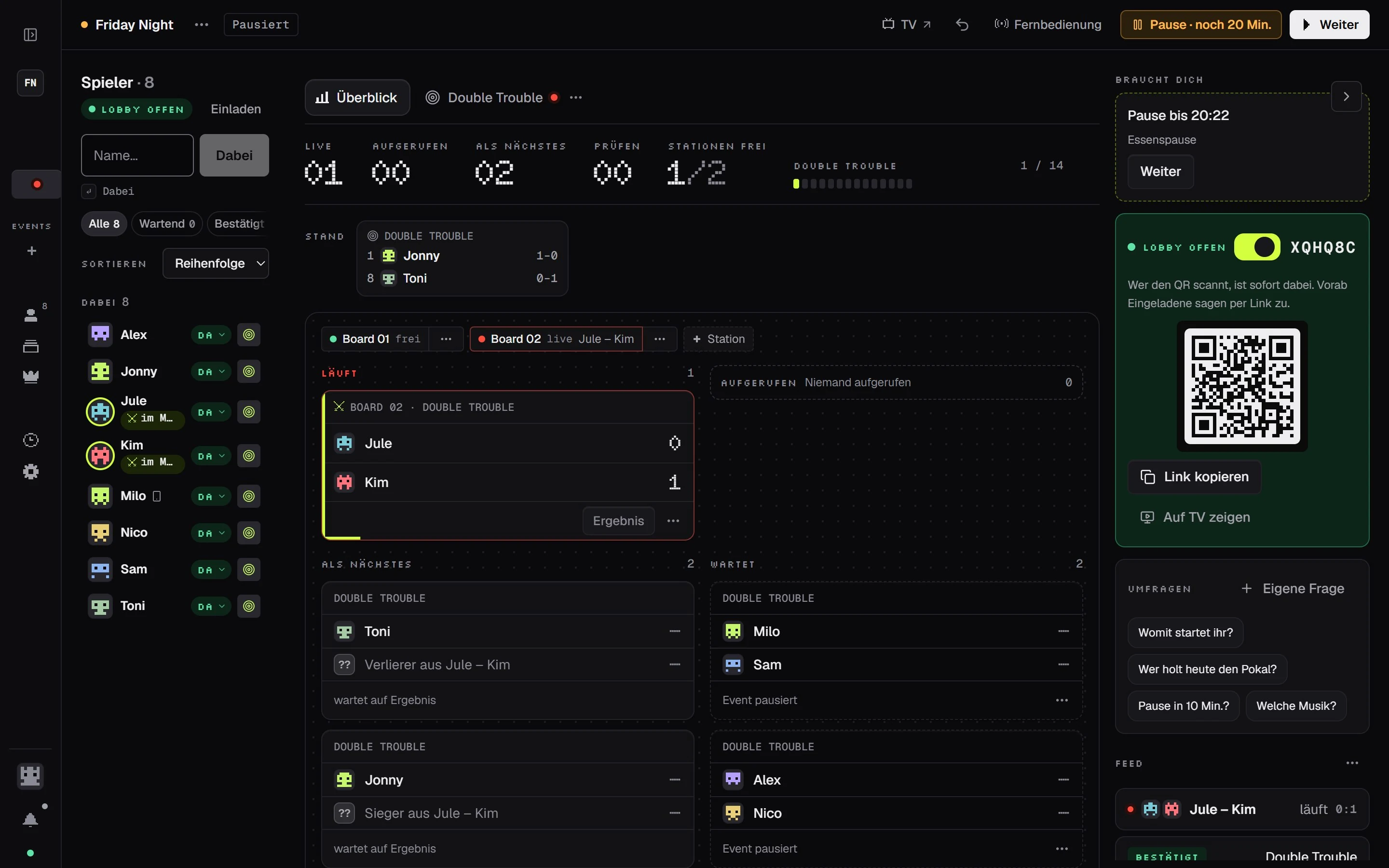
HostShared break, 20 minutes left.
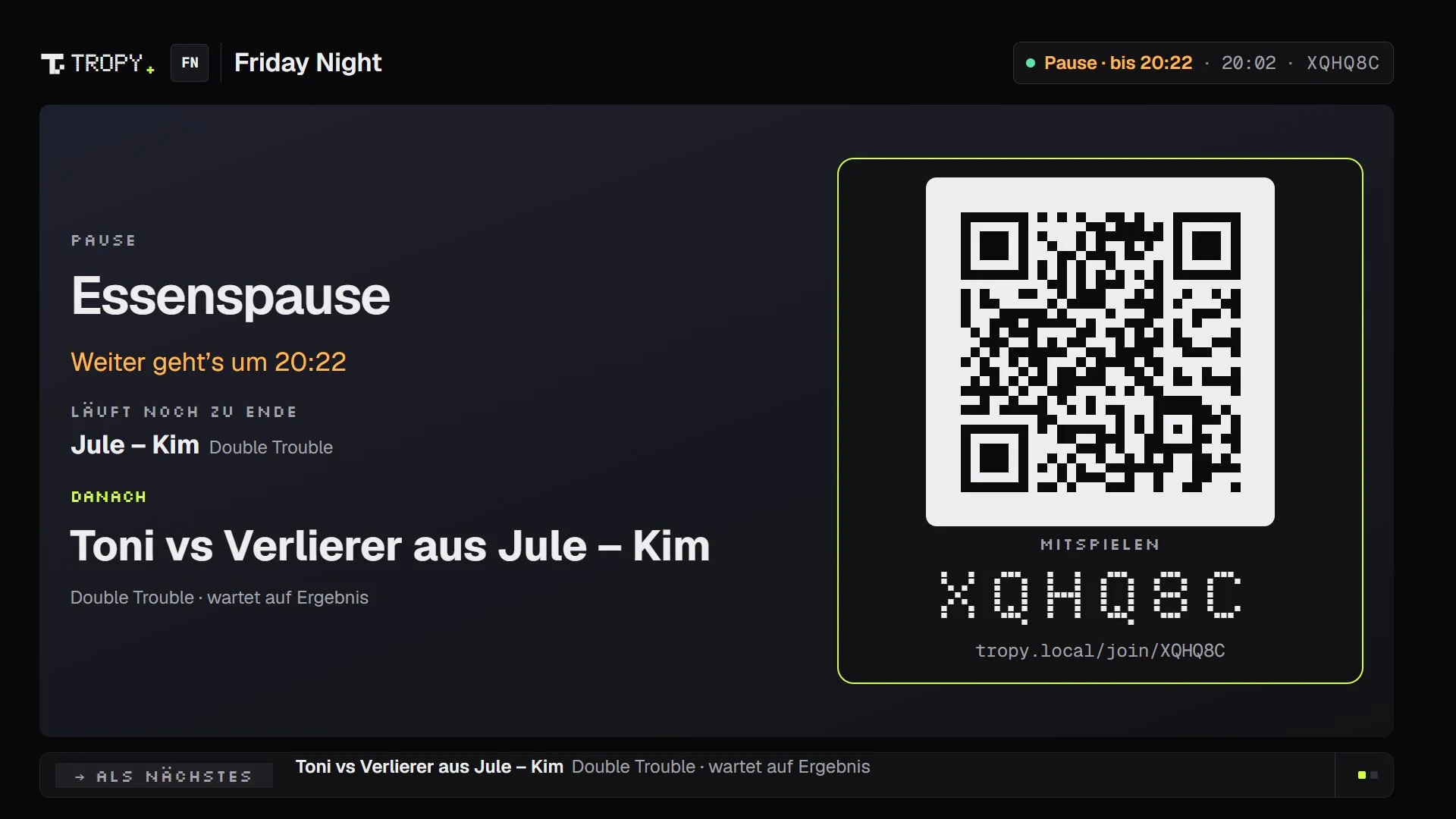
TV stageThe room sees when play continues.
The organiser can also require that they confirm results before they count. TROPY treats the occupancy of a station and the validity of a result separately. A station can already be free for the next match while the previous result is still waiting for confirmation.
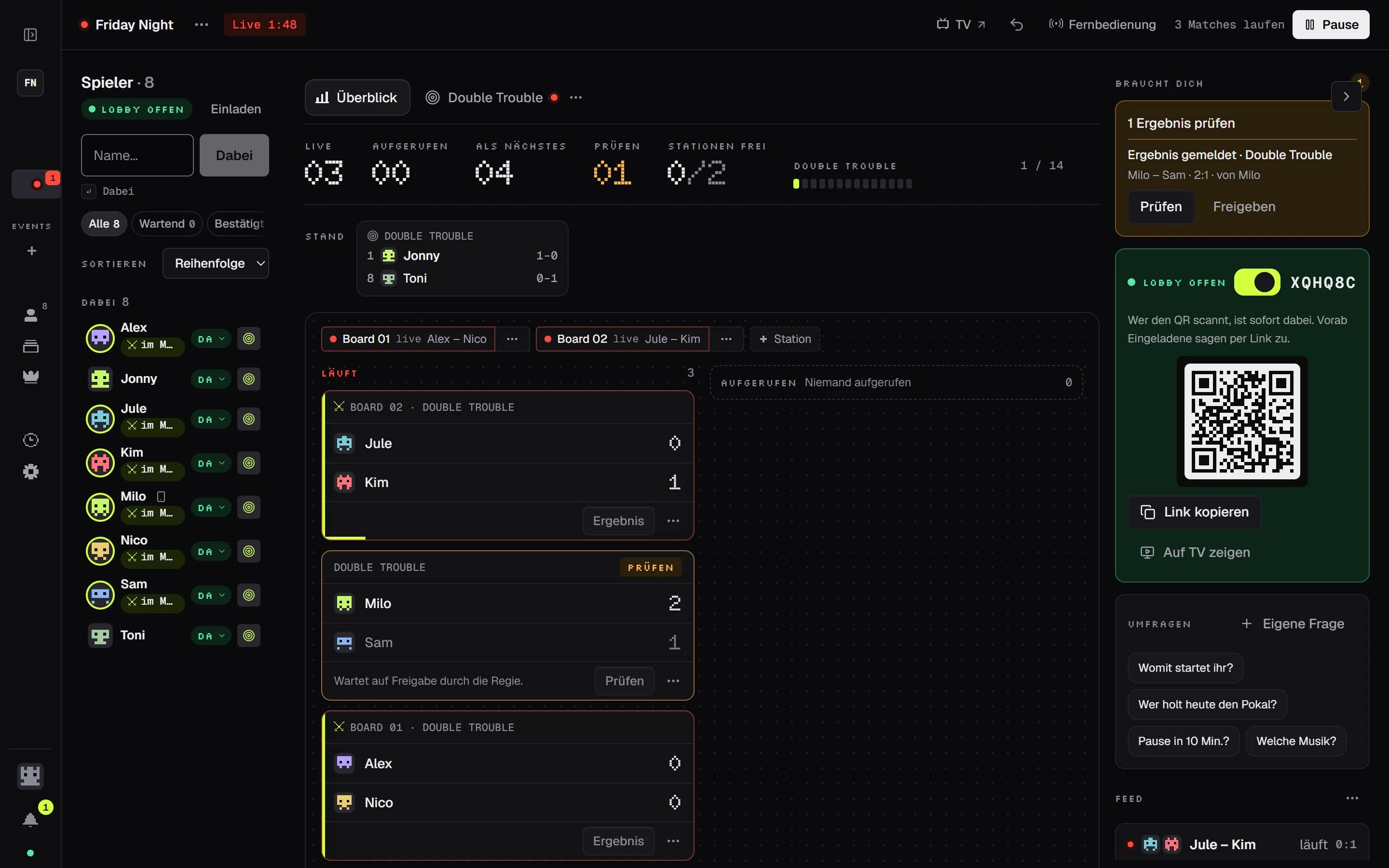
HostOne result to check, Board 01 is occupied again.
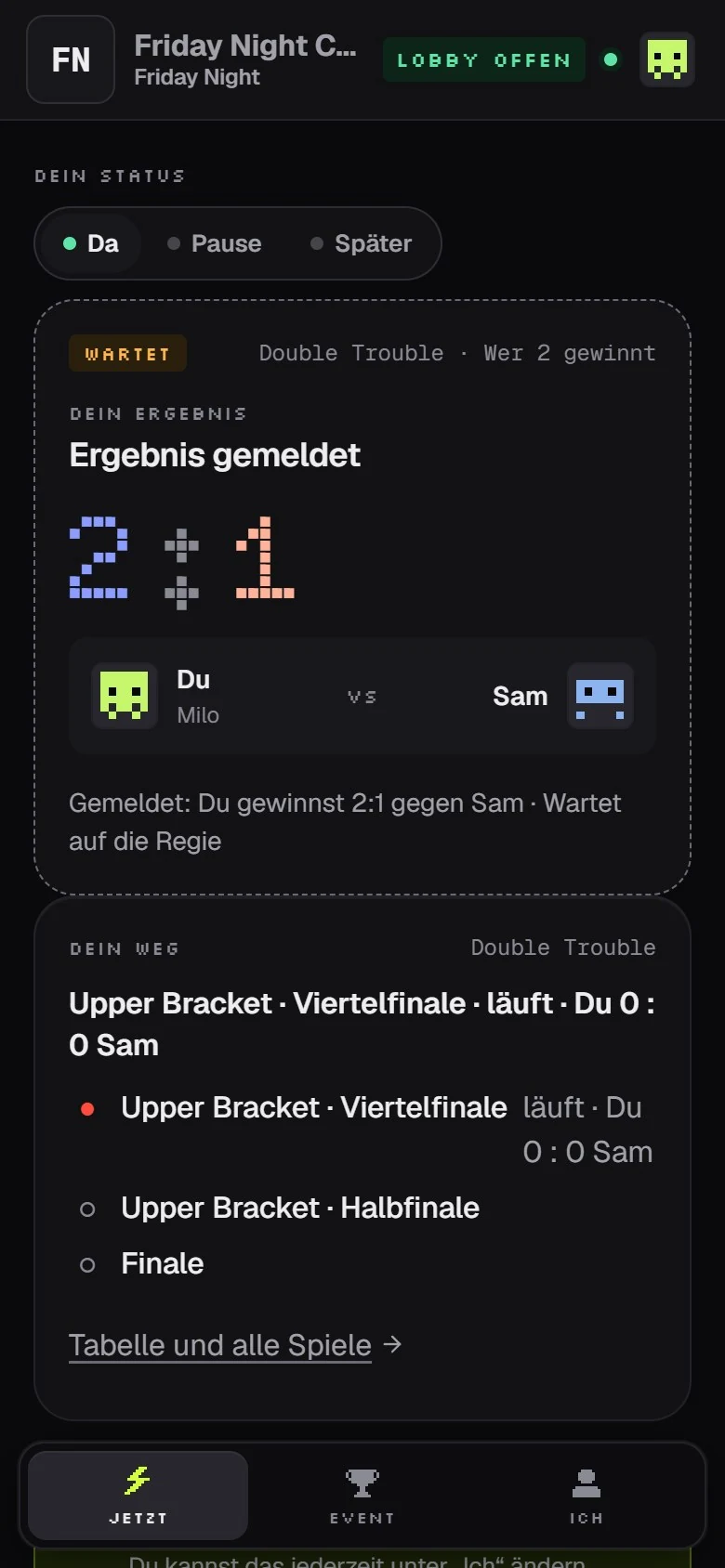
Companion
Decisions
Four core system and design decisions shaped the transition from a single tournament bracket to a multi-device application.
Station release and result confirmation
- Observation
- In the first version of result review, a pending confirmation by the organiser blocked the entire station. Whenever a host was briefly distracted, a queue backed up in front of an actually free board.
- Decision
- I separated the occupancy of a station from the validity of a result. As soon as a match finishes, TROPY releases the station for the next pairing while the reported result waits for confirmation in parallel.
- Trade-off
- Subsequent rounds in the bracket still have to wait until the result is confirmed, and late corrections can invalidate dependent pairings. In return, the physical stations keep running without idle time.
Call-up in the companion
- Observation
- During a review on 4 November 2026, the match call-up sat as a small card below the profile header, and the ready switch stood at the end of a profile tab roughly 3,300 px long. Players could miss their primary action in the room.
- Decision
- The call-up now fills the entire companion screen with the station, opponent and Volt accent. Readiness was integrated directly as a step inside the match flow.
- Trade-off
- The active call-up temporarily covers statistics and the bracket view. In return, players grasp where they need to go at one glance and with one hand.
Tournament setup via the lobby
- Observation
- Previously, the organiser had to assign participants to each tournament individually during setup. With changing groups on the night, that caused duplicate maintenance and delays before the start.
- Decision
- The organiser first sets only which disciplines and rules are played. Participants gather in the shared lobby while the bracket preview grows live and immediately flags incompatible formats.
- Trade-off
- Format conflicts with small or odd player counts have to be caught dynamically and explained in the preview. In return, late arrivals or last-minute drop-outs no longer hold up the start.
Local operation over Wi-Fi
- Observation
- The first version from February 2026 ran through a cloud service with separate tournaments. Mandatory accounts, internet dependency and manual link sharing slowed down onboarding on a casual game night.
- Decision
- In October 2026 I rebuilt TROPY on a local host over Wi-Fi. Guests join via QR code or player PIN without a cloud account, and all three surfaces stay in sync through Server-Sent Events.
- Trade-off
- Without a cloud account there are no cross-device online profiles and no access outside the local network. In return, joining in the room takes only seconds and the evening stays independent of external services.
Iterations
Between February and November 2026, TROPY evolved across five formative steps from a single bracket into a field-tested multi-device system.
- First version, February 2026: The first version managed single tournaments with a bracket and a full-screen view through a cloud service. There was no shared schedule for several disciplines on one night.
- Rebuild as a multi-device system, October 2026: In October the system was rebuilt around the group, event and tournament model, dedicated TV stage, mobile companion and local Wi-Fi hosting.
- Decoupling station and result, end of October 2026: I separated station release from result confirmation onto two tracks so pending reviews would not stall active play.
- Companion and setup overhaul, 4 November 2026: Following a review, the companion received the full-screen call-up and tournament setup switched to the lobby with a live-updating bracket preview.
- Preparation for the field test, 20 November 2026: Shortly before the first live test, Web Push call-up alerts, mid-tournament rule edits and the optional AutoDarts extension were added.
Impact
In November 2026 the first field test took place with a full double-elimination darts tournament across the host console, the TV stage, the companion and the optional AutoDarts extension.
Tournament setup, match assignment, call-ups by notification and the interplay of the three surfaces worked through to the final without verbal clarifications.
At the same time, the live evening exposed concrete bugs in continuous operation, in the AutoDarts bridge and on iOS devices that had not surfaced in prior solo run-throughs.
- Core flow and three surfaces: The entire tournament ran to the final without interruption across host, TV and companion. Call-up notifications reached players reliably, and match assignments needed no verbal follow-up.
- AutoDarts extension in sustained play: In the optional AutoDarts bridge, the login token expired after 30 to 40 minutes and dropped the connection. After bull-off, the system reported the wrong winner in four matches so the score had to be entered by hand, and player permissions to start and confirm matches were ignored by the extension.
- Mobile sync, card layout and iOS: After longer idle periods in the background, the companion immediately displayed a lost connection instead of silently resyncing. In the mobile bracket, AutoDarts cards broke the grid layout, and iPhones saved neither photos nor videos.
- New requirements from the evening: Participants asked for round-specific match rules such as Single Out in early rounds and Double Out from the semi-finals onwards, visible integration of player poses in the flow and optional per-round voting.
Open points
The first field test validated a single discipline (double-elimination darts), not yet an evening with multiple parallel tournaments and changing stations.
Next up are the bug fixes from the field-test log, followed by focused usability tests with 2 to 3 people and a multi-discipline field test.
- DoneOwn run-throughs and automated checks
I played through the core flows myself and verified engine invariants, multi-device browser flows and WCAG AA checks with automated tests.
- DoneFirst field test (single discipline)
A double-elimination darts tournament ran through to completion across the host console, TV stage and companion and produced a concrete bug log.
- OpenFixes from the field test
Token refresh and winner detection in the AutoDarts bridge, silent reconnection in the companion, compact match cards and iOS media saving remain to be fixed.
- PlannedUsability tests
Targeted tasks with 2 to 3 first-time participants are meant to test onboarding and comprehension independently.
- PlannedMulti-discipline field test
A full evening with several parallel tournaments and stations is meant to test the scheduler under full load.
Implementation & image credits
My contribution covers the product concept, system rules, information architecture, interaction and UI design, the Graphite visual system and the field-test evaluation. The technical implementation of the prototype in React, TypeScript, Node.js, SQLite and automated tests was created with AI-assisted coding, without writing the code in these languages by hand.
All screen recordings and screenshots show the running application with sample data. The two photos in the scene collage (living room with dartboard and small football pitch with phone) are AI-generated mockups.
Before the first field test, I additionally checked edge cases and potential usability issues using AI-assisted tournament and usage scenarios. The November 2026 field test covered a single double-elimination darts tournament with the optional AutoDarts extension, from which the documented findings originate.